




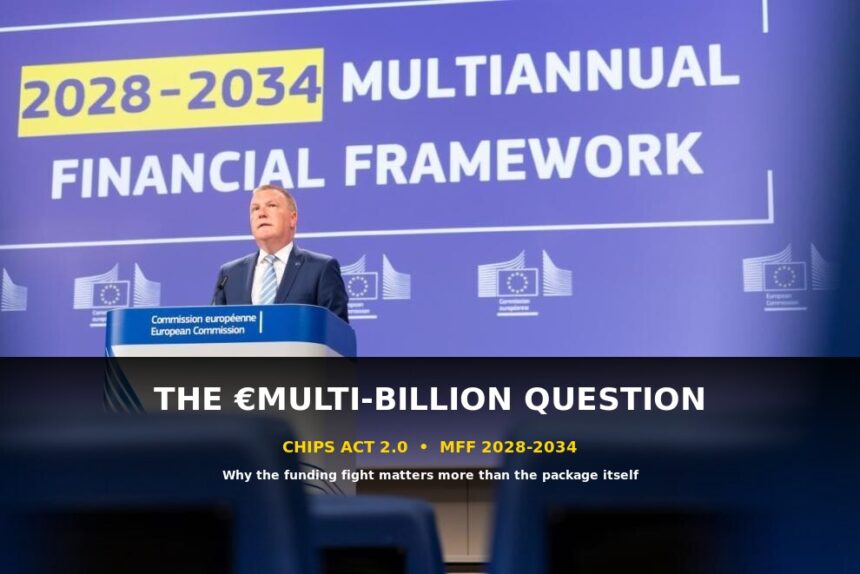
Brussels — The European Commission unveiled its “tech sovereignty” package on June 3 to the usual fanfare: four interlocking bills, a flagship Chips Act 2.0, a Cloud and AI Development Act, named officials, named photo-op. What it did not unveil was the number Europe actually wants to know.
There is no euro figure in the package.
Not a ceiling, not a floor, not a “ten-year envelope” estimate, not even a “we’ll get back to you on that.” Commissioner Henna Virkkunen told reporters the financing would be set in the next Multiannual Financial Framework — the EU’s seven-year budget that runs from 2028 to 2034. That MFF is not yet agreed. It is, by the Commission’s own admission, where the real fight lives.
It is also, by every indicator available, the place where the package is most likely to shrink.
The €3.3 billion question
What the Commission does control is the direct EU-budget line for chips. Under the 2023 European Chips Act, that line was worth about €3.3 billion out of a total envelope of €43 billion — the rest being member-state and private money, routed through the Important Projects of Common European Interest (IPCEI) framework and national aid clearances.
More Read

EE Times’ coverage of the 2026 package says Chips Act 2.0 “allocates a budget of 3.3 billion euros” — the same headline figure. The Reframing Open Strategic Autonomy report cites “3.3 billion from the EU budget.” If that’s accurate, the Commission’s direct contribution to the chips build-out has not moved in three years.
Bits&Chips, the Dutch semiconductor trade publication, was blunter on June 4: “The EC’s figure is 45 billion euros: roughly 11 billion for developing ‘European priorities’ and the rest for follow-on private investment.” The Act’s centerpiece — a pilot line for sub-2nm chips — has been pushed from 2027 to 2030, and the 20% global market share target quietly revised down to 14-16% in internal documents the outlet says it has seen. The Commission has not publicly acknowledged the revision.
Read together, the picture is this: a flagship industrial-policy package whose funding question is the make-or-break variable, gated on a budget fight that has not yet started.

MFF 2028-2034: the €1.76 trillion fight
The Commission’s MFF proposal, unveiled in July 2025, sets a seven-year ceiling of €1.76 trillion (€1.9 trillion including €168 billion for repaying the Next Generation EU recovery instrument) — a 64% increase over the current 2021-2027 period. The proposal also restructures how the money is delivered, merging cohesion, regional, and several other shared-management funds into National and Regional Partnership Plans, a reform the European Parliament has flagged as a power grab toward the Commission.
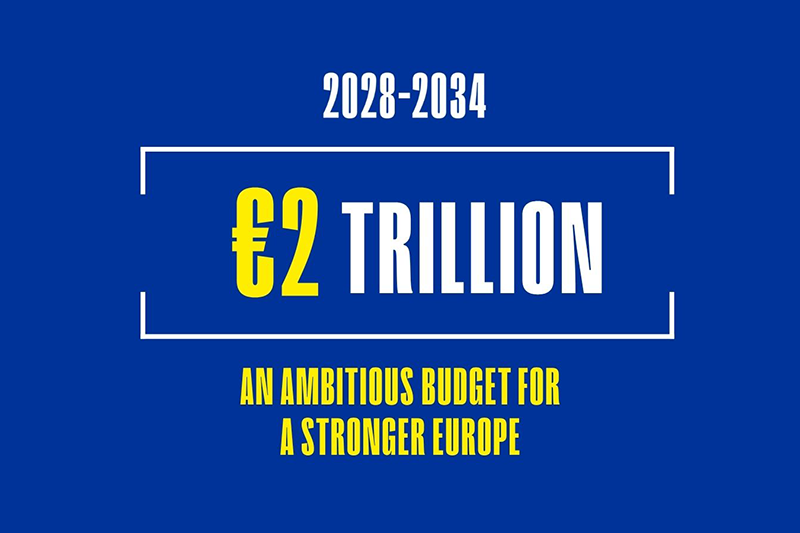
Within that €1.76 trillion, the actual chips line is unspecified in the proposal. The same is true for the Cloud and AI Development Act. The Commission’s 2026 tech sovereignty package is, in budgetary terms, a shopping list without a price tag.
A LinkedIn analysis by policy researcher Mathieu Gitton captured the bind sharply: “The debate on the Chips Act 2.0 will quickly collide with the budgetary question. Since the Chips Act, around 100 billion euros of investment has been announced, but the actual realisation is much lower.” A RAND Europe evidence response on the proposed Cloud and AI Development Act warned last year that legislation alone will not close the AI compute gap — infrastructure investment has to scale in parallel, and the MFF is the only realistic vehicle to do it at the pace Brussels is implying.
“Vague” is a kind word
Industry reaction has not been kind.

Bits&Chips headlined its post-announcement editorial “The EU’s Chips Act is a huge disappointment.” The Financial Times, reporting on the package’s build-up, summarized the European tech industry’s position as: “sovereignty remains somewhat vague and unclear.” The New York Times, framing the same debate back in 2020, called Europe’s “digital sovereignty” plans “still vague” — a label that has stuck because, until last week, nothing in the legislative pipeline was concrete enough to disprove it.
A March 2026 Financial Times investigation, summarized in Chinese state media, found that executives at ASML, Ericsson, and Capgemini had warned Brussels against protectionist measures, arguing the cost of replacing US software, cloud, and AI infrastructure would slow investment, not accelerate it. The same FT report quoted Francesca Musiani of France’s National Centre for Scientific Research: “Private companies cannot justify switching technology on sovereignty grounds alone — any drop in operational efficiency translates into lost market share.” That is, the demand side of CADA is a constraint Brussels cannot legislate away.

A 2021 intervention from then-Competition Commissioner Margrethe Vestager still reads as the most honest budget number in the public domain. To fully meet EU chip demand from domestic production, she said, would require “pre-investment of up to €330 billion.” The Commission’s new package does not contradict that figure. It simply declines to engage with it.
The “Friends of Chips Act 2.0” — and the abstainers
Inside the Council, the politics are equally split.
A “Friends of Chips Act 2.0” group of nine member states — the Netherlands, France, Germany, Italy, Spain, and four others — has been pushing since March 2024 for a roughly quadrupled investment envelope, a dedicated budget line for semiconductors, and faster IPCEI approvals. That coalition is the package’s political base. France and Germany, in particular, have been the engines: their joint September 2025 sovereign cloud initiative pre-figured CADA, and the Paris-Berlin axis is where most of the Crolles and Dresden capacity decisions have actually been made.
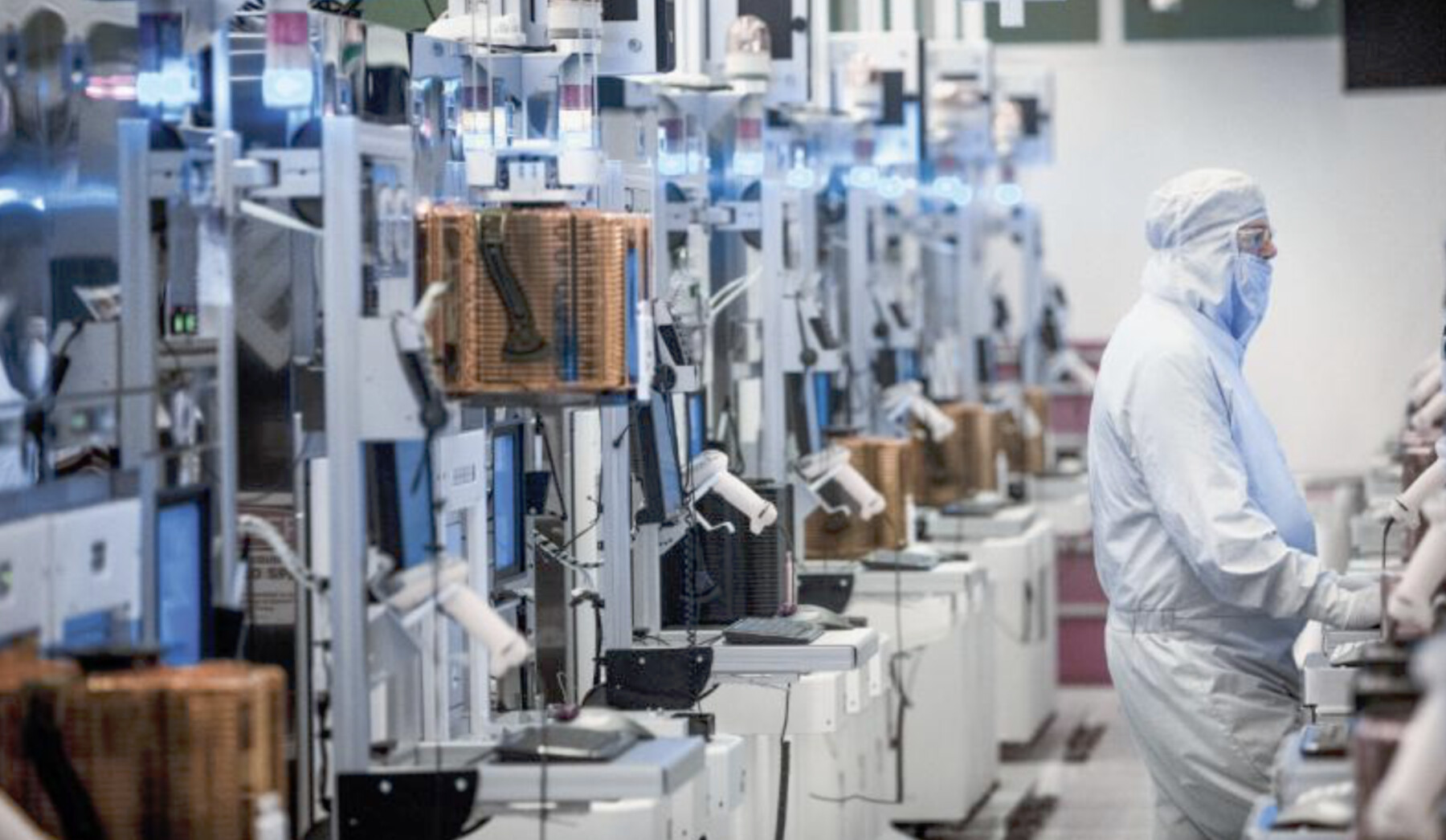
Outside the Friends, the picture is more cautious. A letter from six member states — the Netherlands, Denmark, Ireland, and three others — last year warned against “excessive and untargeted use” of public money for chip manufacturing, citing subsidy-race risks and WTO exposure. Hungary, under Viktor Orbán, has used the same sovereignty language as a veto weapon against other EU initiatives, and Foreign Minister Péter Szijjártó has been explicit that he treats any expansion of qualified-majority voting on tax and budget matters as a red line.
In short: the Council can pass Chips Act 2.0 in principle, but the MFF fight is where the package either gets the money or doesn’t. And the MFF is decided by unanimity.
What it has to beat
For context, the United States CHIPS and Science Act committed $52.7 billion in direct federal funding for semiconductor manufacturing, research, and workforce, plus an estimated $24 billion in tax credits. Roughly $39 billion of that has been allocated to specific projects as of early 2026 — Intel Ohio, TSMC Arizona, Samsung Texas, Micron New York. Whether the projects hit their milestones is a separate question, but the commitment is real and disbursed.
Japan’s METI has committed roughly ¥4 trillion (≈ €25 billion) to TSMC’s Kumamoto fabs and Rapidus’s 2nm project. South Korea’s K-CHIPS Act offers tax credits of up to 25% for chip investment. India’s Semicon India programme has committed $10 billion in central incentives and is subsidising fabs by roughly 50% of capital cost.
Against that lineup, “€3.3 billion from the EU budget” is not a competitive number. The Council’s working assumption seems to be that the package’s real money will come from IPCEI-style joint ventures — a third semiconductor IPCEI already in scoping — and from member-state aid clearances under relaxed state-aid rules. That is also where the “hyperscaler fightback” risk lives: any relaxation strong enough to fund European fabs at scale is also strong enough to subsidise US giants’ European plants.

What’s next
The legislative clock is the same as for the broader package: late 2026 / early 2027 for Council common position and Parliament rapporteur reports; 2027 trialogues; the MFF 2028-2034 deal closed (or not) before the current budget expires at the end of 2027.

Two dates will define whether the package becomes industrial policy or stays a press release: the conclusion of the MFF 2028-2034 negotiations, where the chips and CADA lines get their actual ceilings, and the launch of the third semiconductor IPCEI, which is the only realistic vehicle for the €11 billion in “European priorities” funding Bits&Chips says the Commission has pencilled in.
Europe’s industrial-policy moment is real. The package was not a stunt, and the four pieces fit together coherently. The test is whether the 27 finance ministers can agree, in 2027, on a budget large enough to make it work — and whether the Commission’s own line item moves past €3.3 billion.
Until then, the gap between the press conference and the spreadsheet is where the politics lives.
Sources: European Commission press corner (IP/26/1187); Council of the EU MFF 2028-2034 proposal (July 2025); EE Times; Bits&Chips (June 4, 2026); Financial Times; Reframing Open Strategic Autonomy in the EU Digital Ecosystem (IAI, 2026); RAND Europe evidence response on CADA; EuroStack Industry Group open letters; Austrian Federal Ministry; Centre for Cybersecurity Policy; Mathieu Gitton (LinkedIn).